

Most old photos are not just “low quality.” They have real damage: scratches, fading, missing details. Standard AI tools often make this worse. They sharpen the defects instead of fixing them.
This list covers tools that actually work on photo problems. The selection is short, but each option serves a different purpose. You will not find ten similar tools here, just four with clear differences.
1. Renew Photo
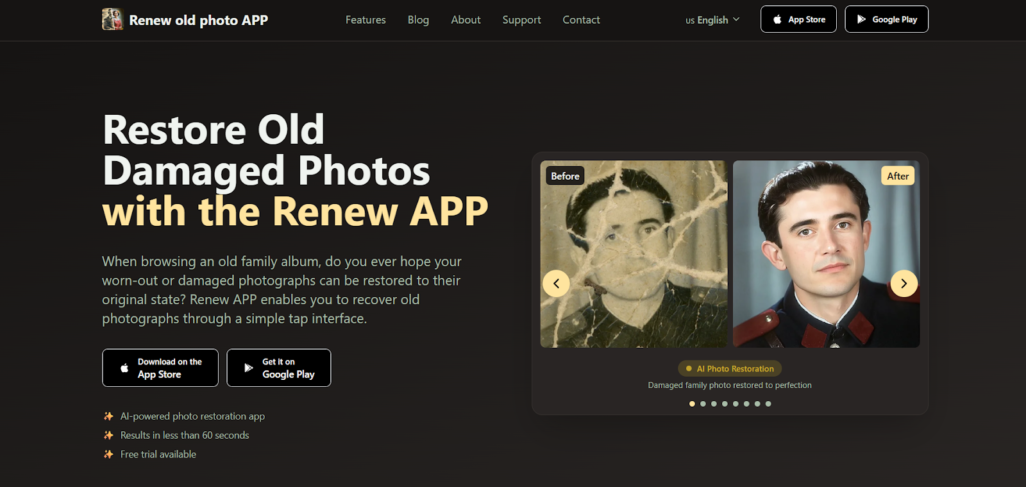
This online tool handles complete restoration without any manual input. You upload a photo, and it does the work. No sliders, no settings, no guesswork.
According to our analysts, Renew Photo works across different types of damage: physical wear, color loss, and faded areas. The results are consistent, which matters when you process multiple photos.
Why this tool works as a universal solution for most restoration tasks comes down to several factors:
- Fixes both visible damage and faded areas in one pass;
- Reconstructs missing details rather than simply sharpening what remains;
- Handles mixed issues like scratches and color loss simultaneously;
- Requires no editing skills or technical knowledge;
- Works consistently across different photo types and damage levels.
For most users, this is the most balanced option available.
2. RetroFix
RetroFix goes for speed. It does basic restoration without complex settings. The interface is minimal, and the process is straightforward.
This tool fits situations where you want a result in seconds, not minutes. It is especially practical on a phone: open, upload, download. No extra steps.
The tool emphasizes speed and simplicity above all else:
- Fast restoration that completes in just a few seconds;
- Works well on mobile devices with minimal screen navigation;
- Simple workflow: upload, process, export with no intermediate steps;
- Handles light damage and moderate blur effectively;
- Free access to basic features without account requirements.
When you need a quick fix and nothing more, this works.
3. YouCam Enhance

YouCam Enhance takes a more aggressive approach. It handles tougher damage: deeper scratches, stronger fading, and older images with multiple issues.
The tool produces noticeable results. Sometimes the processing is heavy, but that is the point. For photos that other tools struggle with, this one often delivers.
What sets this tool apart is its focus on visible quality improvement:
- Removes scratches and visible defects that simpler tools might miss;
- Enhances color and contrast automatically without manual tuning;
- Improves clarity on heavily damaged photos with significant wear;
- Works without requiring manual adjustments or technical knowledge;
- Suitable for older and degraded images that need stronger processing.
For “difficult” photos, this is a better fit.
4. Canva AI Photo Restoration
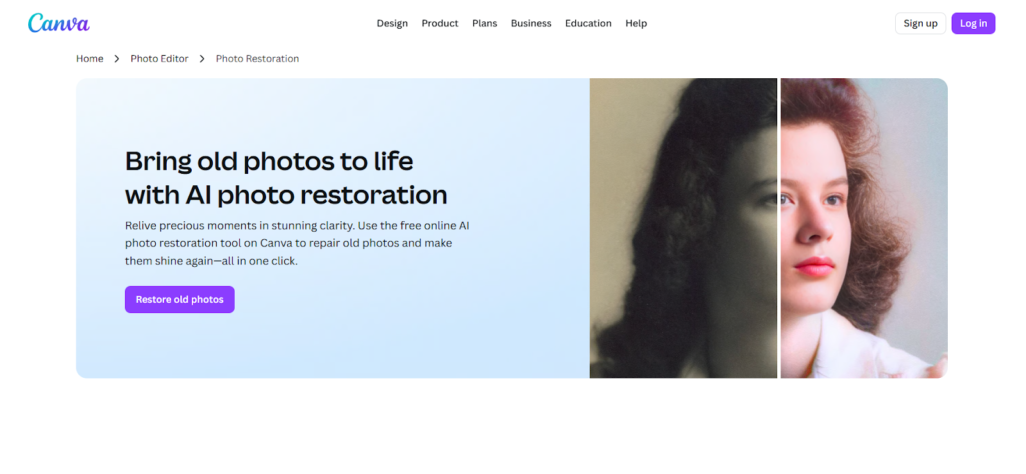
Canva AI Photo Restoration sits inside a larger platform. It is not a standalone tool. This matters because it offers something others do not: editing after restoration.
You fix the photo, then you crop, adjust, add text, or do whatever else you need. All in one place. No switching between apps.
The strength here is combining restoration with editing capabilities:
- One-click restoration inside a full-featured editor;
- Fixes faded colors and minor damage without extra steps;
- Allows further editing after restoration completes;
- Beginner-friendly interface that matches the main Canva platform;
- Works across multiple devices with cloud syncing.
For users who need both restoration and editing, this is the most practical choice.
Which One Should You Actually Use
The right tool depends on what you need to fix. Ranking does not matter here. What matters is matching the tool to the problem.
A few simple scenarios help make the choice faster:
- Use Renew Photo when you want full restoration without effort;
- Choose RetroFix for quick fixes where speed matters most;
- Pick YouCam Enhance for heavily damaged photos that need aggressive processing;
- Use Canva if you also need editing tools after restoration.
The photo itself decides which tool works best.
Common Mistakes When Restoring Old Photos
Many users expect instant, perfect results from any AI tool. In practice, the outcome depends not only on the tool, but also on the condition of the original image. Some issues cannot be fully fixed in a single pass.
The most common problem is overprocessing. When a tool tries to sharpen too aggressively, it can create artificial details that were never there. This makes the photo look unnatural instead of restored.
Another mistake is choosing the wrong type of tool. Some users apply lightweight enhancers to heavily damaged photos. In these cases, the result will always be limited, no matter how good the algorithm is.
To avoid these issues, it helps to keep a few simple points in mind:
- Start with the highest resolution version of the photo available;
- Avoid tools that only sharpen without reconstruction;
- Do not expect perfect results from severely damaged images;
- Test more than one tool for difficult cases;
- Focus on overall clarity rather than artificial sharpness.
In many cases, combining the right tool with a realistic expectation leads to much better results than relying on automation alone.
Final Thoughts
AI tools now actually restore photos. They do not just sharpen and call it done. The four above each handle different situations: Renew Photo for balance, RetroFix for speed, YouCam Enhance for heavy damage, and Canva for editing after restoration. Pick the one that matches your photo.